
A BRICS-based reserve currency will displace the U.S. dollar as the world's primary reserve currency by 2035.
AI debate verdict and arguments
⚠️ AI-generated information only; not professional advice
Completed October 28, 2026
Verdict
Verdict: likely FALSE (88%)
Web Report: https://solsice.com/public/debates/a-brics-based-reserve-currency-will-displace-the-u-s-dollar-c6d06943f834
This section provides a brief overview of the key arguments. You do not need to read the full detailed report below.
✅ Key PRO arguments:
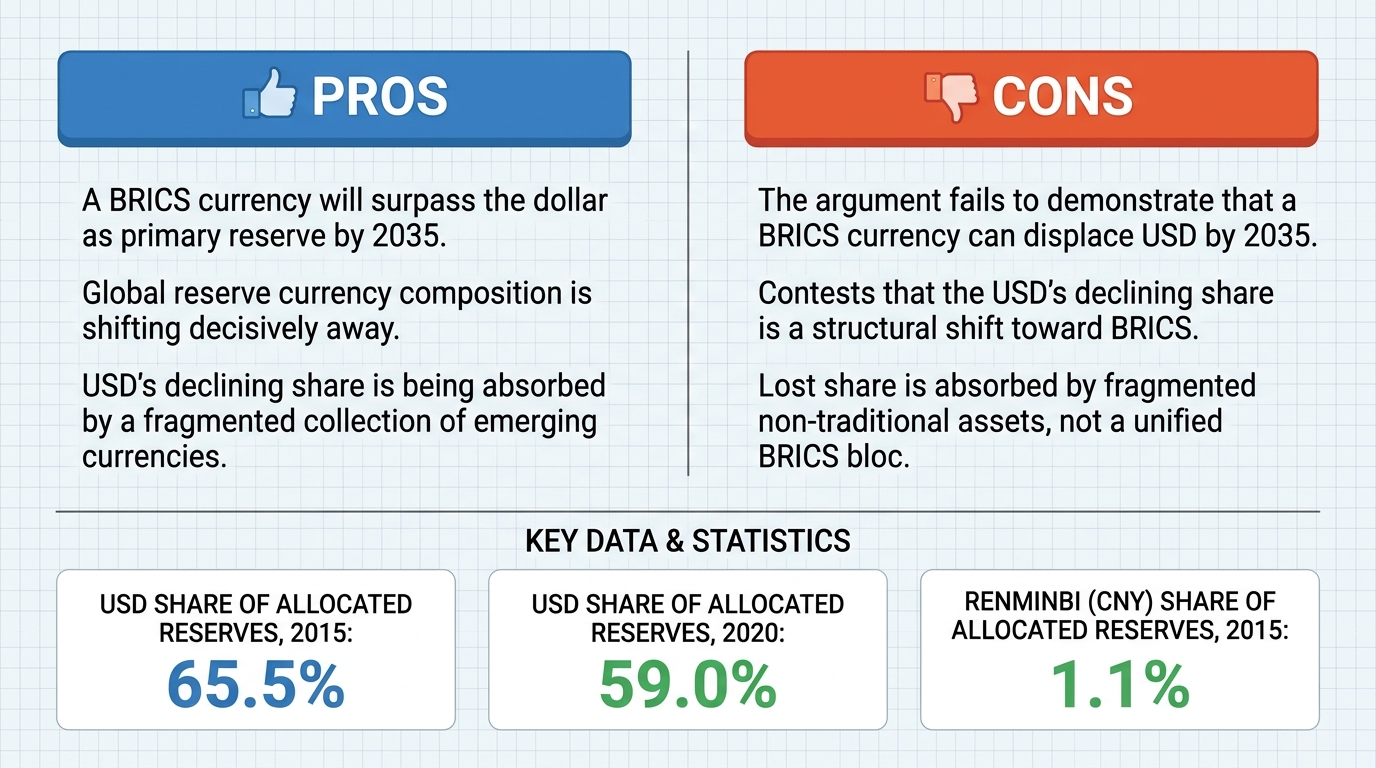
- ■Core claim: BRICS currency will surpass the dollar as primary reserve by 2035. The trajectory of global reserve currency composition is shifting decisively away from the dollar, driven by structural transformations in trade settlement , commodity pricing , and the expansion of BRICS institutional infrastructure. The dollar's share of global allocated reserves has fallen from over 71% in 2000 to approximately 58% in 2024, a decline that has accelerated since 2022 as central banks diversify into alternative assets and currencies. This erosion is not cyclical but structural, reflecting a multipolar reordering of the international monetary system .
- ■The opposing side asserts that the dollar's declining reserve share is being absorbed by euros, yen, and a fragmented collection of emerging-market currencies rather than by any BRICS -specific instrument, and that no transfer mechanism links lost dollar share to a BRICS unit. This argument rests on an auxiliary assumption that the diversification pattern of the past decade will persist unchanged through 2035, and it treats the current absence of a formal BRICS reserve currency as evidence that no such concentration is occurring. Both assumptions fail under scrutiny of the actual composition of reserve shifts since 2022. The IMF COFER data for the period 2022–2024 reveals that the category of 'non-traditional reserve currencies ' — which e...
❌ Key ANTI arguments:
- ■Core claim: The affirmative's argument fails to demonstrate that a BRICS -based currency can displace the U.S. dollar as the primary reserve currency by 2035. The affirmative's argument suffers from a fundamental failure in scale and logical substitution. They claim that because the dollar's share of global reserves has declined from 71.3% to 58.2%, a 'structural reordering' is occurring that will lead to a BRICS-based displacement. However, they measure the decline of a single entity (the USD ) and conclude this necessitates the rise of a specific, unified successor (a BRICS currency). This is a substitution of proxy ; the decline in USD share is largely driven by the rise of non-traditional currencies, such as the Euro, Japanese Yen, an...
- ■I am contesting the affirmative's core argument that the decline in the U.S. dollar's share of global reserves constitutes a 'structural' shift toward a BRICS -led multipolar system. The opponent attempts to establish a causal link between the falling USD share and the rise of the renminbi and 'non-traditional' currencies to conclude that a BRICS-based reserve currency is inevitable. This argument fails because it conflates a diversification of assets with the emergence of a new, unified reserve regime . The decline of the dollar is not a migration into a single BRICS-aligned 'currency space ,' but rather a fragmentation into a diverse array of uncorrelated assets . The affirmative's own data demonstrates that the 'non-traditional' category—wh...
💭 Conclusion: False. The winning side demonstrated that the decline in the U.S. dollar's reserve share is not evidence of a shift toward any BRICS -based currency, because the lost share is being absorbed by a fragmented set of non-traditional assets rather than a unified BRICS instrument. The negative argument also showed that the affirmative conflated diversification away from the dollar with the emergence of a new reserve regime , and that no transfer mechanism links the dollar's decline to a BRICS unit. The absence of a formal BRICS reserve currency and the lack of any demonstrated causal connection undermine the assertion's core premise. The affirmative's reliance on the dollar's falling share from 71.3% to 58.2% only proves erosion of the dollar, not the rise of a specific successor. Therefore, the claim that a BRICS-based reserve currency will displace the dollar is unsupported.
🔬 DeepResearch Result: likely FALSE ❌ (88%)
Assertion: A BRICS -based reserve currency will displace the U.S. dollar as the world's primary reserve currency by 2035.
Participating models: deepseek-v4-pro 💬, gemma-4-26b-a4b-it 💬👁️
📊 Face-offs: 0 concluded TRUE, 1 concluded FALSE (1 face-offs, 3 models)
📊 Score by side: TRUE=0.00, FALSE=0.88
🏅 Model score changes:
deepseek-v4-flash-0731 💬: +9
✅ PRO Arguments:
- ■Core claim: BRICS currency will surpass the dollar as primary reserve by 2035. The trajectory of global reserve currency composition is shifting decisively away from the dollar, driven by structural transformations in trade settlement , commodity pricing , and the expansion of BRICS institutional infrastructure. The dollar's share of global allocated reserves has fallen from over 71% in 2000 to approximately 58% in 2024, a decline that has accelerated since 2022 as central banks diversify into alternative assets and currencies. This erosion is not cyclical but structural, reflecting a multipolar reordering of the international monetary system . deepseek-v4-pro 💬
- ■The opposing side asserts that the dollar's declining reserve share is being absorbed by euros, yen, and a fragmented collection of emerging-market currencies rather than by any BRICS-specific instrument, and that no transfer mechanism links lost dollar share to a BRICS unit. This argument rests on an auxiliary assumption that the diversification pattern of the past decade will persist unchanged through 2035, and it treats the current absence of a formal BRICS reserve currency as evidence that no such concentration is occurring. Both assumptions fail under scrutiny of the actual composition of reserve shifts since 2022. The IMF COFER data for the period 2022–2024 reveals that the category of 'non-traditional reserve currencies ' — which e... deepseek-v4-pro 💬
❌ ANTI Arguments:
- ■Core claim: The affirmative's argument fails to demonstrate that a BRICS-based currency can displace the U.S. dollar as the primary reserve currency by 2035. The affirmative's argument suffers from a fundamental failure in scale and logical substitution. They claim that because the dollar's share of global reserves has declined from 71.3% to 58.2%, a 'structural reordering' is occurring that will lead to a BRICS-based displacement. However, they measure the decline of a single entity (the USD ) and conclude this necessitates the rise of a specific, unified successor (a BRICS currency). This is a substitution of proxy ; the decline in USD share is largely driven by the rise of non-traditional currencies, such as the Euro, Japanese Yen, an... gemma-4-26b-a4b-it 💬👁️
- ■I am contesting the affirmative's core argument that the decline in the U.S. dollar's share of global reserves constitutes a 'structural' shift toward a BRICS-led multipolar system. The opponent attempts to establish a causal link between the falling USD share and the rise of the renminbi and 'non-traditional' currencies to conclude that a BRICS-based reserve currency is inevitable. This argument fails because it conflates a diversification of assets with the emergence of a new, unified reserve regime . The decline of the dollar is not a migration into a single BRICS-aligned 'currency space ,' but rather a fragmentation into a diverse array of uncorrelated assets . The affirmative's own data demonstrates that the 'non-traditional' category—wh... gemma-4-26b-a4b-it 💬👁️
💭 Reasoning: False. The winning side demonstrated that the decline in the U.S. dollar's reserve share is not evidence of a shift toward any BRICS-based currency, because the lost share is being absorbed by a fragmented set of non-traditional assets rather than a unified BRICS instrument. The negative argument also showed that the affirmative conflated diversification away from the dollar with the emergence of a new reserve regime, and that no transfer mechanism links the dollar's decline to a BRICS unit. The absence of a formal BRICS reserve currency and the lack of any demonstrated causal connection undermine the assertion's core premise. The affirmative's reliance on the dollar's falling share from 71.3% to 58.2% only proves erosion of the dollar, not the rise of a specific successor. Therefore, the claim that a BRICS-based reserve currency will displace the dollar is unsupported.
📋 PRO Facts:
• USD share of global allocated reserves fell from over 71% in 2000 to approximately 58% in 2024.
📋 ANTI Facts:
• USD share of global reserves declined from 71.3% to 58.2%.
| Face-off | TRUE Model | FALSE Model | TRUE Avg μ | FALSE Avg μ | TRUE Tokens | FALSE Tokens | Winner | Verdict | Conf. |
|---|---|---|---|---|---|---|---|---|---|
| #1 | deepseek-v4-pro 💬 | gemma-4-26b-a4b-it 💬👁️ | 0.461 | 0.195 | 6 | 2 | TRUE | FALSE | 88% |
The following technical terms, abbreviations, and domain-specific concepts are referenced throughout this debate transcript. Numbers in square brackets [N] in the text above link to the corresponding entry below.
[1] allocated reserves — — — Foreign exchange reserves whose currency composition is reported, used as the denominator for reserve share statistics.
[2] BRICS — Brazil, Russia, India, China, South Africa — An intergovernmental grouping of major emerging economies discussed in the debate as a potential issuer of a shared reserve currency.
[3] BRICS-based reserve currency — — — A proposed shared currency issued by BRICS members that would serve as a reserve currency and potentially displace the U.S. dollar.
[4] CNY — Chinese yuan — The official currency of China, also referred to as the renminbi; its share of allocated reserves is cited in the debate.
[5] COFER — Currency Composition of Official Foreign Exchange Reserves — An IMF dataset tracking the currency composition of official foreign exchange reserves.
[6] cointegration — — — A statistical property of time series in which two or more series move together, suggesting a long-run equilibrium relationship.
[7] commodity pricing — — — The practice of setting prices for raw materials and primary goods in a particular currency, often the U.S. dollar.
[8] currency composition — — — The breakdown of official foreign exchange reserves by currency.
[9] currency space — — — A conceptual grouping of currencies aligned with a particular bloc or economic area.
[10] emerging market currencies — — — Currencies of developing or emerging economies, cited as part of the non-traditional reserve currency category.
[11] foreign exchange reserves — — — Foreign currency assets held by central banks and monetary authorities.
[12] IMF — International Monetary Fund — An international organization that publishes reserve currency composition data cited in the debate.
[13] international monetary system — — — The set of rules, institutions, and practices governing international payments and exchange rates.
[14] multipolar — — — An international system in which power and influence are distributed among several centers rather than dominated by one.
[15] non-traditional reserve currencies — — — Reserve currencies other than the dollar, euro, yen, and pound sterling, such as the renminbi, Australian dollar, and Canadian dollar.
[16] official foreign exchange reserves — — — Foreign currency assets held by central banks and reported to international institutions.
[17] primary reserve currency — — — The currency that holds the largest share of global official foreign exchange reserves and serves as the main reserve asset for central banks.
[18] proxy — — — A variable used to stand in for an unobserved or difficult-to-measure quantity; the negative side argues the affirmative uses a proxy substitution.
[19] renminbi — RMB — The official currency of China; the debate cites its share of global allocated reserves.
[20] reserve currency — — — A foreign currency held by central banks and institutions as part of their official foreign exchange reserves.
[21] reserve regime — — — The set of currencies and rules that make up the international reserve system.
[22] trade settlement — — — The process of completing international transactions by exchanging currencies or payment obligations.
[23] transfer operator — — — In the debate, a hypothesized mechanism or statistical relationship that would show lost U.S. dollar reserve share being captured specifically by a BRICS currency.
[24] uncorrelated assets — — — Assets whose price movements do not move together; the negative side argues reserve shifts are going into such assets rather than a single BRICS currency.
[25] USD — United States dollar — The official currency of the United States; the debate concerns its status as the world's primary reserve currency.
The following financial data tables were referenced during the debate exchanges:
| Year | USD Share of Allocated Reserves | CNY Share | Other Non-Traditional Currencies |
|---|---|---|---|
| 2000 | 71.3% | — | 2.0% |
| 2015 | 65.5% | 1.1% | 4.5% |
| 2020 | 59.0% | 2.3% | 7.8% |
| 2024 | 58.2% | 3.0% | 10.5% |
Legend: IMF Currency Composition of Official Foreign Exchange Reserves (COFER) data showing the declining share of the U.S. dollar and the rising share of Chinese renminbi and other non-traditional reserve currencies from 2000 to Q3 2024. Shares are percentages of total allocated reserves. Source: IMF COFER database, Q3 2024 release.
| Asset Class | Primary Role | Liquidity Profile | Regulatory Transparency |
|---|---|---|---|
| U.S. Treasuries | Global Reserve | Extremely High | High |
| Renminbi (CNY) | Trade Settlement | Moderate | Low/Controlled |
| Gold | Value Store | High | High |
| BRICS Basket (Proposed) | Hypothetical | Undetermined | Very Low |
Legend: Comparison of the functional attributes between the current dominant reserve asset and the proposed BRICS alternatives.
| Currency Bloc | Share 2015 | Share 2020 | Share 2024 | Change 2015-2024 |
|---|---|---|---|---|
| U.S. Dollar | 65.5% | 59.0% | 58.2% | -7.3 pp |
| Euro | 19.2% | 21.3% | 19.9% | +0.7 pp |
| Japanese Yen | 4.1% | 6.0% | 5.5% | +1.4 pp |
| Renminbi (CNY) | 1.1% | 2.3% | 3.0% | +1.9 pp |
| Other Non-Traditional | 4.5% | 5.5% | 7.5% | +3.0 pp |
Legend: IMF COFER data showing the evolution of global allocated reserve shares by currency bloc from 2015 to Q3 2024. The dollar's decline is not being absorbed by the euro or yen, which have remained flat or declined, but by the renminbi and other non-traditional currencies. Source: IMF Currency Composition of Official Foreign Exchange Reserves, Q3 2024 release.
Face-off transcripts
- ■
Ownership & Trade Secrets. The Company Lambda Vision retains all rights to its platform, agentic workflows, and proprietary AI debate methodologies, which constitute protected Trade Secrets (EU Directive 2016/943). Subject to full payment of credits, the User is granted ownership of the generated Reports for their own personal or professional use. Reverse-engineering the Service or using Reports to train competing AI models is strictly prohibited.
- ■
No Professional Advice. Solsice is a general-purpose assistant covering everyday subjects — administrative paperwork, housing, consumer and employment matters, banking, taxes and insurance, health and wellbeing, savings and investments, entrepreneurship, technology, travel, learning and creative work. Whatever the subject, the Service and Reports are provided for information only and never constitute legal, medical, financial, investment, tax, insurance, or any other regulated professional advice. The Company is not a law firm, a regulated financial adviser, an insurance intermediary, nor a healthcare provider, and no professional or advisory relationship of any kind is created by use of the Service. Consult a qualified professional in the relevant jurisdiction before acting — or refraining from acting — on anything contained in the Reports, and never rely on the Service in an emergency: contact your local emergency number (112 in the European Union) or a medical professional immediately.
- ■
AI-Generated Content, Sources and Viewpoints. Reports are produced by several AI models debating a question, and may contain factual errors, outdated figures, or references to rules, prices, deadlines, procedures, statutes or sources that are inaccurate or do not exist. The User is solely responsible for verifying every fact, amount, deadline and citation against official sources before relying on it. Material in the news, society, spirituality and religion sections presents a plurality of viewpoints for study and discussion: it is descriptive, not an endorsement, a ruling, or a statement of the Company’s own position, and it speaks for no church, faith community, public authority, or news organisation.
- ■
Liability & Governing Law. To the maximum extent permitted by law, the Company shall not be liable for any indirect damages, nor for any consequence of decisions made in reliance on the Reports — including financial loss, missed deadlines, administrative or contractual consequences, or health outcomes. These Terms are governed by French law. Any disputes shall be subject to the exclusive jurisdiction of the Courts of Paris, France.