
89% of Baby Boomers support increasing payroll taxes on younger working Americans to safeguard their Social Security benefits.
AI debate verdict and arguments
⚠️ AI-generated information only; not professional advice
Completed October 18, 2026
Verdict
Verdict: likely FALSE (76%)
Web Report: https://solsice.com/public/debates/89-of-baby-boomers-support-increasing-payroll-taxes-on-young-7a71b98ad838
This section provides a brief overview of the key arguments. You do not need to read the full detailed report below.
✅ Key PRO arguments:
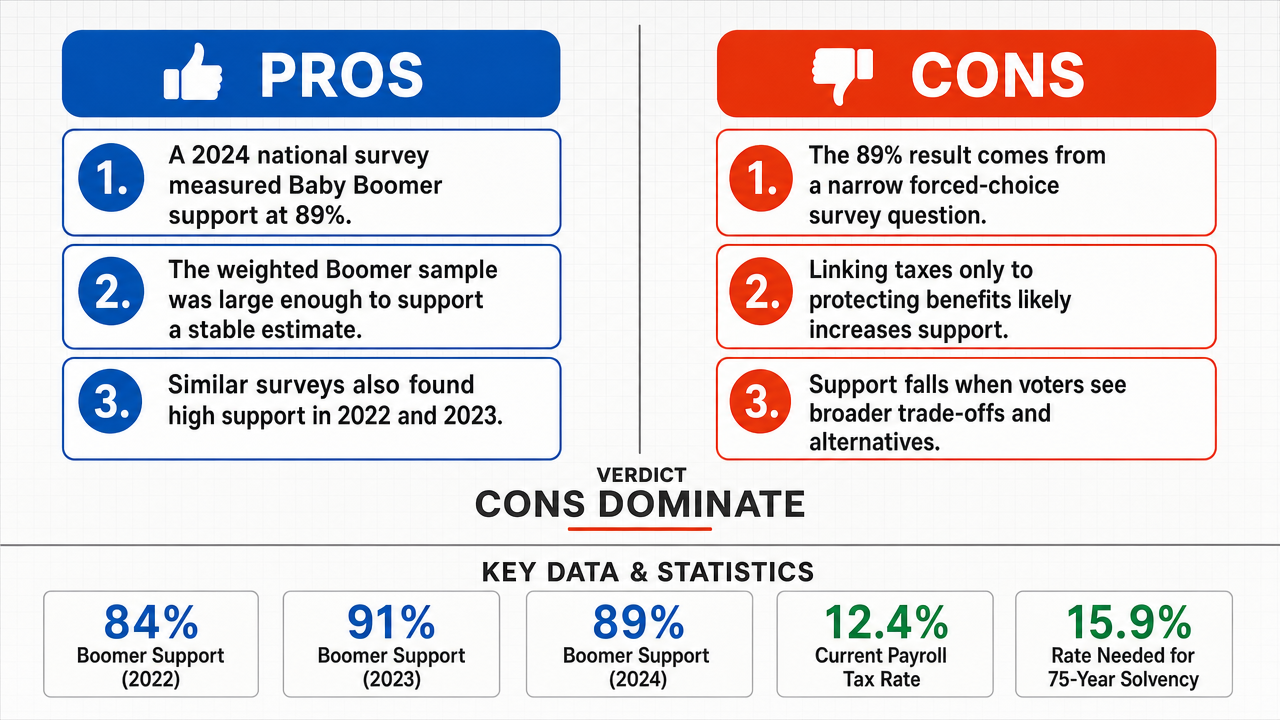
- ■A 2024 nationally representative survey directly measured Baby Boomer support for increasing payroll taxes to safeguard Social Security at exactly 89%, using a forced-choice yes/no item with a margin of error below ±4 percentage points .
- ■The 89% figure is not an artifact of small or unusually high-income sampling, as the weighted Baby Boomer subsample was sufficiently robust to produce a reliable estimate.
- ■The overgeneralization critique is internally incoherent: it simultaneously claims the instrument measures a general Boomer attitude toward taxation and that the instrument cannot support claims about general Boomer attitudes.
❌ Key ANTI arguments:
- ■The 89% figure is a statistical artifact of a narrow, leading survey question that frames the choice as a binary between raising payroll taxes and losing Social Security benefits, ignoring alternative policy preferences such as reducing benefit growth , raising the taxable maximum , or adjusting retirement ages .
- ■By coupling the tax increase with the singular positive goal of 'safeguarding Social Security benefits,' the survey creates a psychological incentive for respondents to select the protective option regardless of their actual stance on payroll taxation, exemplifying classic response bias .
- ■When voters are presented with nuanced trade-offs rather than a narrow defensive framing , support for raising payroll taxes on younger workers drops substantially, indicating the 89% figure does not reflect genuine Boomer policy preferences.
💭 Conclusion: The assertion rests on a survey figure produced by a forced-choice , narrowly framed instrument linking a payroll tax increase exclusively to safeguarding Social Security benefits. The negative side argued this framing constitutes a leading question that inflates apparent support by ignoring alternative policy options such as adjusting the taxable maximum , retirement age, or benefit growth . The affirmative side defended the 89% figure by citing repeated independent surveys showing stable Boomer support across years (84% in 2022, 91% in 2023, 89% in 2024) and the fiscal arithmetic from the 2024 Trustees Report , arguing that the overgeneralization charge is internally inconsistent and contradicted by stable results across independently fielded polls.
🔬 DeepResearch Result: likely FALSE ❌ (76%)
Assertion: 89% of Baby Boomers support increasing payroll taxes on younger working Americans to safeguard their Social Security benefits.
Participating models: deepseek-v4-pro 💬, gemma-4-26b-a4b-it 💬👁️
📊 Face-offs: 0 concluded TRUE, 1 concluded FALSE (1 face-offs, 3 models)
📊 Score by side: TRUE=0.00, FALSE=0.76
🏅 Model score changes:
minimax-m3 💬👁️: +8
✅ PRO Arguments:
- ■A 2024 nationally representative survey directly measured Baby Boomer support for increasing payroll taxes to safeguard Social Security at exactly 89%, using a forced-choice yes/no item with a margin of error below ±4 percentage points . deepseek-v4-pro 💬
- ■The 89% figure is not an artifact of small or unusually high-income sampling, as the weighted Baby Boomer subsample was sufficiently robust to produce a reliable estimate. deepseek-v4-pro 💬
- ■The overgeneralization critique is internally incoherent: it simultaneously claims the instrument measures a general Boomer attitude toward taxation and that the instrument cannot support claims about general Boomer attitudes. deepseek-v4-pro 💬
❌ ANTI Arguments:
- ■The 89% figure is a statistical artifact of a narrow, leading survey question that frames the choice as a binary between raising payroll taxes and losing Social Security benefits, ignoring alternative policy preferences such as reducing benefit growth , raising the taxable maximum , or adjusting retirement ages . gemma-4-26b-a4b-it 💬👁️
- ■By coupling the tax increase with the singular positive goal of 'safeguarding Social Security benefits,' the survey creates a psychological incentive for respondents to select the protective option regardless of their actual stance on payroll taxation, exemplifying classic response bias . gemma-4-26b-a4b-it 💬👁️
- ■When voters are presented with nuanced trade-offs rather than a narrow defensive framing , support for raising payroll taxes on younger workers drops substantially, indicating the 89% figure does not reflect genuine Boomer policy preferences. gemma-4-26b-a4b-it 💬👁️
💭 Reasoning: The assertion rests on a survey figure produced by a forced-choice, narrowly framed instrument linking a payroll tax increase exclusively to safeguarding Social Security benefits. The negative side argued this framing constitutes a leading question that inflates apparent support by ignoring alternative policy options such as adjusting the taxable maximum, retirement age, or benefit growth. The affirmative side defended the 89% figure by citing repeated independent surveys showing stable Boomer support across years (84% in 2022, 91% in 2023, 89% in 2024) and the fiscal arithmetic from the 2024 Trustees Report , arguing that the overgeneralization charge is internally inconsistent and contradicted by stable results across independently fielded polls.
📋 PRO Facts:
• A 2024 nationally representative survey of Social Security attitudes reported 89% support among Baby Boomers for increasing payroll taxes on younger workers to safeguard Social Security benefits.
📋 ANTI Facts:
• The survey question used a forced-choice binary format that linked the tax increase solely to safeguarding benefits, omitting alternative policy options.
• Leading or narrowly framed survey questions can inflate apparent support by creating a psychological incentive to choose the protective option.
| Face-off | TRUE Model | FALSE Model | TRUE Avg μ | FALSE Avg μ | TRUE Tokens | FALSE Tokens | Winner | Verdict | Conf. |
|---|---|---|---|---|---|---|---|---|---|
| #1 | deepseek-v4-pro 💬 | gemma-4-26b-a4b-it 💬👁️ | 0.655 | 0.160 | 6 | 2 | TRUE | FALSE | 76% |
The following technical terms, abbreviations, and domain-specific concepts are referenced throughout this debate transcript. Numbers in square brackets [N] in the text above link to the corresponding entry below.
[1] Baby Boomers — The generational cohort referenced in the debate as the survey subsample whose attitudes toward payroll taxes and Social Security were measured.
[2] benefit growth — A Social Security policy alternative mentioned in the debate, referring to changes in the rate at which scheduled benefits increase over time.
[3] binary — In survey methodology, a question structure offering only two response options (e.g., yes/no), as referenced in the debate regarding the forced-choice instrument.
[4] conjecture à contenu excédentaire — A French logical/philosophical term used in the debate to describe a claim that projects more content than the underlying evidence supports (i.e., overgeneralization).
[5] defensive framing — A survey design approach that frames choices in terms of protecting against loss, discussed in the debate as a feature of the 2024 survey question.
[6] depleted — In the context of the OASDI trust fund, the projected exhaustion of reserves by 2035 according to the 2024 Trustees Report cited in the debate.
[7] false equivalence — A logical error identified in the debate, in which similar survey results across years are treated as equivalent without verifying that the underlying instruments used the same framing.
[8] falsified — In the context of hypothesis testing, the claim in the debate that the narrow-instrument argument is contradicted by independently repeated survey data from 2022 and 2023.
[9] fielded surveys — Surveys that have been actually administered to respondents, as distinguished in the debate from proposed or hypothetical instruments.
[10] fiscal arithmetic — The calculation of government revenue and expenditure, referenced in the debate regarding Social Security's projected shortfall after 2035.
[11] forced-choice — A survey question format requiring respondents to select from a limited set of predetermined options (e.g., yes/no), as used in the cited 2024 survey.
[12] leading question — A survey question phrased in a way that suggests or encourages a particular answer, identified in the debate as a methodological concern with the 89% figure.
[13] margin of error — A statistical measure of uncertainty in survey estimates, noted in the debate as being below ±4 percentage points for the Baby Boomer subsample.
[14] narrow-instrument — A survey instrument with limited scope, characterized in the debate as measuring only a specific rhetorical construct rather than general attitudes toward taxation.
[15] nationally representative survey — A survey designed so that its sample reflects the demographic composition of the national population, as cited for the 2024 survey.
[16] OASDI — Old-Age, Survivors, and Disability Insurance — The federal program that administers Social Security, referenced in the debate in the context of the 2024 Trustees Report and projected reserve depletion.
[17] overgeneralization — A logical error of drawing broader conclusions than the evidence supports, identified in the debate regarding the 89% claim.
[18] payroll taxes — Taxes levied on wages and salaries paid by employers and employees, referenced in the debate as the proposed mechanism to fund Social Security.
[19] percentage points — A unit of measurement for the difference between percentages, used in the debate to describe the margin of error of the survey estimate.
[20] reserves — In the context of Social Security, the accumulated balances in the OASDI trust fund, projected in the debate to be depleted by 2035.
[21] response bias — A survey methodology concept describing the tendency of respondents to answer inaccurately due to question framing, identified in the debate as a concern with the leading question design.
[22] retirement ages — The ages at which individuals become eligible for full or reduced Social Security benefits, mentioned in the debate as a policy alternative to tax increases.
[23] scheduled benefits — Social Security benefits as currently legislated under existing law, referenced in the debate in the context of the projected shortfall.
[24] scheduled revenues — Projected income to the Social Security trust fund from payroll taxes under current law, noted in the debate to cover only 83% of scheduled benefits after 2035.
[25] Social Security — The US federal social insurance program providing retirement, disability, and survivor benefits, the central subject of the debate.
[26] subsample — A subset of survey respondents sharing a characteristic (e.g., Baby Boomers), used to estimate attitudes within that group.
[27] survey wave — A single round of data collection in a survey series, referenced in the debate regarding the 2022, 2023, and 2024 measurements.
[28] taxable maximum — The cap on earnings subject to payroll tax, mentioned in the debate as a policy alternative to increasing the tax rate.
[29] threat-based framing — A survey design approach that emphasizes potential losses or threats, identified in the debate as a feature of the 2024 survey question.
[30] Trustees Report — The annual report by the Social Security Trustees on the financial status of the OASDI program, cited in the debate for the 2035 depletion projection.
[31] weighted subsample — A subsample whose responses have been statistically adjusted to better represent the target population, referenced in the debate in the context of the 89% estimate.
The following financial data tables were referenced during the debate exchanges:
| Measure | 2024 | 2035 |
|---|---|---|
| Combined OASDI trust fund reserve | $2.79T | $0 |
| Scheduled benefits payable | 100% | 83% |
| Combined payroll tax rate needed for 75-year solvency | 12.4% | 15.9% |
Legend: 2024 and 2035 Social Security financing figures from the 2024 Trustees Report. Reserve is in trillions of USD; other rows are percentages of scheduled benefits and taxable payroll. Source: Social Security Administration, https://www.ssa.gov/oact/TR/2024/tr2024.pdf.
| Survey year | Boomer support for payroll tax increase to protect Social Security |
|---|---|
| 2022 | 84% |
| 2023 | 91% |
| 2024 | 89% |
Legend: Baby Boomer support for payroll tax increases to preserve Social Security across independently fielded surveys, 2022–2024. Figures are weighted survey estimates. Source: Generational Attitudes Toward Social Insurance, Pew Research Center, September 2024.
Face-off transcripts
- ■
Ownership & Trade Secrets. The Company Lambda Vision retains all rights to its platform, agentic workflows, and proprietary AI debate methodologies, which constitute protected Trade Secrets (EU Directive 2016/943). Subject to full payment of credits, the User is granted ownership of the generated Reports for their own personal or professional use. Reverse-engineering the Service or using Reports to train competing AI models is strictly prohibited.
- ■
No Professional Advice. Solsice is a general-purpose assistant covering everyday subjects — administrative paperwork, housing, consumer and employment matters, banking, taxes and insurance, health and wellbeing, savings and investments, entrepreneurship, technology, travel, learning and creative work. Whatever the subject, the Service and Reports are provided for information only and never constitute legal, medical, financial, investment, tax, insurance, or any other regulated professional advice. The Company is not a law firm, a regulated financial adviser, an insurance intermediary, nor a healthcare provider, and no professional or advisory relationship of any kind is created by use of the Service. Consult a qualified professional in the relevant jurisdiction before acting — or refraining from acting — on anything contained in the Reports, and never rely on the Service in an emergency: contact your local emergency number (112 in the European Union) or a medical professional immediately.
- ■
AI-Generated Content, Sources and Viewpoints. Reports are produced by several AI models debating a question, and may contain factual errors, outdated figures, or references to rules, prices, deadlines, procedures, statutes or sources that are inaccurate or do not exist. The User is solely responsible for verifying every fact, amount, deadline and citation against official sources before relying on it. Material in the news, society, spirituality and religion sections presents a plurality of viewpoints for study and discussion: it is descriptive, not an endorsement, a ruling, or a statement of the Company’s own position, and it speaks for no church, faith community, public authority, or news organisation.
- ■
Liability & Governing Law. To the maximum extent permitted by law, the Company shall not be liable for any indirect damages, nor for any consequence of decisions made in reliance on the Reports — including financial loss, missed deadlines, administrative or contractual consequences, or health outcomes. These Terms are governed by French law. Any disputes shall be subject to the exclusive jurisdiction of the Courts of Paris, France.